
Introduction
AI marketing tools have transformed how businesses create content, analyze customer behavior, manage advertising campaigns, and improve sales. Instead of relying on manual work alone, marketers now use artificial intelligence to automate repetitive tasks, predict customer interests, and make data-driven decisions.
Whether you own a small business, run an online store, manage social media, or work for a large company, AI-powered marketing solutions can help you save time while improving campaign performance.
This guide is based on industry-recognized AI research, educational resources, and current technology developments. It explains how AI marketing tools work, their benefits, limitations, practical applications, and the latest trends shaping digital marketing in 2026.
What Are AI Marketing Tools?
AI marketing tools are software platforms that use artificial intelligence to improve marketing activities. They combine machine learning, natural language processing, predictive analytics, and automation to help businesses understand customers, create better content, and increase conversions.
Unlike traditional software that only performs predefined tasks, AI-powered marketing platforms learn from customer interactions and continuously improve recommendations over time.
For example, an AI marketing platform can analyze thousands of customer purchases, website visits, and email responses to identify buying patterns. It then recommends personalized products, creates targeted campaigns, and predicts which customers are most likely to make a purchase.
This intelligent decision-making enables marketers to work more efficiently while delivering better customer experiences.
How AI Marketing Tools Work
AI marketing tools begin by collecting information from various sources such as websites, social media platforms, customer relationship management systems, email campaigns, and online advertisements.
The collected data is processed using machine learning algorithms that identify trends and patterns. The system then generates insights that marketers can use to improve campaigns.
Modern AI marketing platforms also rely on large language models to generate blog posts, email campaigns, product descriptions, advertising copy, and customer support responses.
Many tools continue learning as new data becomes available, allowing recommendations and predictions to become increasingly accurate over time.
Types of AI Marketing Tools
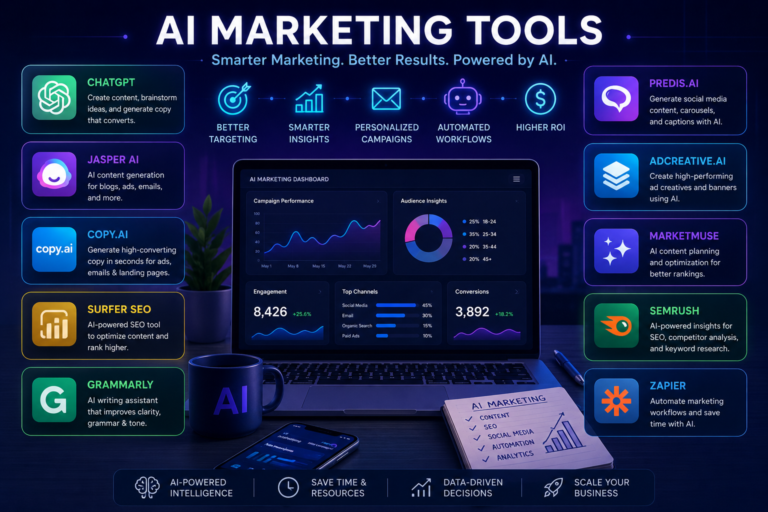
AI marketing software is available in several categories, each designed for a specific purpose.
Content creation tools generate articles, social media posts, email newsletters, advertising copy, and product descriptions while maintaining consistent tone and style.
SEO tools analyze keywords, competitors, backlinks, and website performance to improve search engine rankings.
Email marketing platforms personalize subject lines, automate customer journeys, and optimize delivery times based on user behavior.
Social media management tools schedule content, recommend posting times, monitor engagement, and identify trending topics.
Advertising optimization platforms automatically adjust campaign budgets, target audiences, and bidding strategies to improve return on investment.
Customer analytics tools examine purchasing behavior, customer lifetime value, and audience segmentation to support better marketing decisions.
AI Marketing Tools vs Traditional Marketing Software
Traditional marketing software depends heavily on manual input. Marketers often need to create reports, analyze campaign results, and adjust strategies themselves.
AI marketing tools go much further by analyzing massive amounts of data automatically and recommending actions before marketers even recognize opportunities.
Instead of simply displaying information, AI predicts future customer behavior, automates repetitive tasks, personalizes customer experiences, and continuously improves campaign performance using machine learning.
The result is faster decision-making, greater efficiency, and more effective marketing strategies. check out more about AI Agents click HERE
Machine Learning in Marketing
Machine learning is one of the most important technologies behind AI marketing.
It allows software to learn from historical customer data without being manually programmed for every situation.
For example, an online retailer can use machine learning to recommend products based on previous purchases, browsing history, and customer preferences.
As more users interact with the website, the recommendation engine becomes increasingly accurate, leading to higher customer satisfaction and increased sales.
Machine learning is also widely used for fraud detection, customer segmentation, demand forecasting, pricing optimization, and campaign performance prediction.
Generative AI for Marketing
Generative AI has become one of the most influential technologies in digital marketing.
Instead of simply analyzing information, it creates original content including articles, advertisements, marketing emails, product descriptions, images, presentation outlines, and customer support responses.
Marketing teams use generative AI to speed up content production while maintaining quality and consistency.
Although AI-generated content saves time, human review remains essential to ensure factual accuracy, originality, and brand voice.
The most successful organizations combine AI efficiency with human creativity rather than replacing human expertise entirely.

Real-World Marketing Applications
Businesses across nearly every industry now use AI marketing tools to improve customer engagement.
Retail companies personalize product recommendations based on shopping behavior.
Travel companies recommend destinations using customer preferences.
Streaming platforms suggest movies and music based on viewing history.
E-commerce stores automate abandoned-cart emails.
Marketing agencies use AI to create campaign ideas, generate reports, monitor competitors, and optimize advertising performance.
These practical applications help organizations improve customer satisfaction while reducing operational costs.
Benefits of AI Marketing Tools
AI marketing tools provide significant advantages for businesses of all sizes.
They automate repetitive work, allowing marketing teams to focus on creativity and strategic planning.
They analyze large datasets far faster than humans, uncovering valuable customer insights that might otherwise remain hidden.
AI also improves personalization by delivering relevant recommendations, customized emails, and targeted advertising based on individual customer behavior.
Campaign optimization becomes faster because AI continuously evaluates performance and recommends improvements in real time.
Businesses also benefit from better forecasting, higher productivity, improved customer experiences, and stronger returns on marketing investments.
Risks and Challenges
Despite their advantages, AI marketing tools also present challenges.
Generated content may occasionally contain inaccuracies or outdated information, making human review essential.
Customer privacy remains an important concern because AI systems rely on large amounts of personal data. Organizations should comply with data protection regulations and maintain transparency about how information is collected and used.
Bias in training data can also affect recommendations and advertising decisions if datasets are not representative.
Businesses should combine AI insights with professional judgment rather than relying entirely on automated systems.
AI Marketing in Business
Companies increasingly integrate AI into their daily marketing operations.
Sales teams use predictive analytics to identify promising leads.
Marketing departments automate campaign management across multiple channels.
Customer service teams deploy AI chatbots that provide instant assistance throughout the day.
Business leaders use AI dashboards to monitor performance, forecast sales, and allocate marketing budgets more effectively.
As AI technology continues to evolve, organizations are discovering new ways to improve efficiency while strengthening customer relationships.
AI Marketing in Healthcare
Healthcare organizations use AI marketing responsibly to educate patients, promote wellness programs, and improve communication.
Hospitals personalize appointment reminders and preventive healthcare campaigns using patient preferences while following privacy regulations.
Healthcare providers also analyze campaign performance to understand community needs and improve public health awareness initiatives.
AI Marketing in Education
Educational institutions use AI marketing to attract prospective students, personalize communication, and recommend suitable courses.
Universities analyze enrollment trends, automate student inquiries, and create personalized email campaigns based on individual interests.
These tools improve engagement while helping institutions communicate more effectively with students and parents.
AI Marketing in Finance
Financial institutions rely on AI marketing tools to personalize banking services, recommend financial products, and improve customer communication.
Banks analyze customer behavior to identify relevant offers while maintaining strict security and regulatory compliance.
AI also supports fraud detection, customer segmentation, and campaign optimization across digital banking platforms.
Future of AI Marketing
The future of AI marketing will focus on deeper personalization, predictive decision-making, multimodal content generation, privacy-aware AI, and greater collaboration between humans and intelligent systems.
Businesses are expected to adopt AI agents capable of planning campaigns, analyzing competitors, monitoring customer sentiment, and recommending marketing strategies with minimal supervision.
Responsible AI development, transparency, and ethical data use will become increasingly important as artificial intelligence becomes more deeply integrated into marketing operations.
Best AI Marketing Tools in 2026
Several AI marketing platforms continue leading the industry in 2026.
ChatGPT assists with content writing, brainstorming, customer support, and marketing strategy development.
Google Gemini helps businesses research information, summarize documents, and generate marketing content.
Claude supports long-form writing, document analysis, and business communication.
Jasper specializes in AI-powered marketing copy and brand-consistent content creation.
Copy.ai focuses on sales messaging, product descriptions, and email campaigns.
HubSpot AI combines customer relationship management with AI-powered marketing automation.
Canva AI simplifies graphic design and marketing asset creation for businesses of all sizes.
Each platform serves different marketing needs, and many organizations use several tools together to build efficient marketing workflows.
How Beginners Can Learn AI Marketing
Beginners should first understand digital marketing fundamentals, including SEO, content marketing, email marketing, analytics, and social media management.
After learning these basics, explore AI-powered tools through hands-on practice.
Experiment with content generation, campaign optimization, keyword research, customer segmentation, and analytics dashboards.
Study prompt writing techniques, marketing automation workflows, and responsible AI practices.
Continuous learning is important because AI technology evolves rapidly, with new capabilities emerging every year.
Frequently Asked Questions
.
- What are AI marketing tools?
AI marketing tools are software platforms that use artificial intelligence to automate marketing tasks, analyze customer data, create content, personalize campaigns, and improve marketing performance through machine learning and predictive analytics.
- Can small businesses use AI marketing tools?
Yes. Many affordable AI platforms are designed specifically for startups and small businesses, helping them automate marketing without requiring large teams or advanced technical skills.
- Are AI marketing tools replacing marketers?
No. AI supports marketers by automating repetitive work and providing insights. Human creativity, strategic thinking, and ethical decision-making remain essential.
- Which industries benefit most from AI marketing?
Retail, healthcare, finance, education, travel, hospitality, software, manufacturing, and e-commerce all benefit significantly from AI-powered marketing.
- Is AI-generated content good for SEO?
AI-generated content can support SEO when it is accurate, original, helpful, and reviewed by humans to ensure quality and relevance.
- Do AI marketing tools require programming knowledge?
Most modern platforms are designed for non-technical users and provide easy-to-use interfaces with little or no coding required.
- Are AI marketing tools secure?
Reputable providers implement strong security measures, but businesses should review privacy policies, protect customer data, and follow applicable regulations.
- What skills are useful for AI marketing?
Digital marketing, SEO, analytics, content creation, prompt writing, data interpretation, and basic AI concepts are valuable skills.
- How does AI improve customer experience?
AI personalizes recommendations, delivers faster support, automates responses, and provides relevant content based on customer preferences and behavior.
- What is the future of AI marketing?
AI marketing will continue becoming more personalized, predictive, automated, and integrated across business operations while placing greater emphasis on ethical AI and responsible data use.
Conclusion
AI marketing tools are reshaping how businesses connect with customers, create content, analyze data, and improve marketing performance. By combining artificial intelligence with human creativity, organizations can deliver more personalized experiences, automate repetitive tasks, and make smarter decisions based on real-time insights. Whether you are a beginner or an experienced marketer, learning how to use AI responsibly will remain an essential skill as digital marketing continues to evolve. Continue exploring emerging AI technologies, practice with leading platforms, and stay informed about new developments to build effective, ethical, and future-ready marketing strategies.