
Introduction
The US vs China AI race in 2026 has become one of the defining technology competitions of the decade. Artificial intelligence is no longer simply a story about chatbots, research laboratories, or futuristic software. It is increasingly connected to economic competitiveness, semiconductor manufacturing, cloud infrastructure, robotics, national security, scientific research, and global technological influence.
The United States entered 2026 with major advantages in frontier AI models, computing infrastructure, leading AI companies, and access to advanced semiconductor technology. China, however, has rapidly narrowed parts of the gap by producing increasingly capable models, developing domestic chips, expanding AI infrastructure, and pushing artificial intelligence into manufacturing and robotics.
The competition is therefore more complicated than asking which country has the “best AI.” Leadership can mean different things: developing the most capable models, producing the largest amount of AI hardware, deploying AI most widely, controlling supply chains, or influencing the standards other countries adopt.
This guide is based on industry-recognized AI research, educational resources, and current technology developments.
Why the US vs China AI Race is more important
Artificial intelligence is becoming a general-purpose technology that can affect almost every major sector of an economy. Countries that build strong AI ecosystems can potentially gain advantages in productivity, scientific discovery, manufacturing, software development, and technological innovation.
The competition also has an international dimension. In July 2026, Chinese President Xi Jinping presented China as an alternative center of global AI leadership and promoted international cooperation around AI, while China launched the World AI Cooperation Organisation with 29 member nations. The United States, meanwhile, has been developing its own technology alliances, including the Pax Silica initiative.
This means the contest is not happening only in Silicon Valley and Beijing. Countries in Southeast Asia, the Middle East, Africa, Europe, and elsewhere increasingly have to decide which technologies, suppliers, standards, and partnerships they want to adopt.
The United States' AI Advantage
America’s greatest advantage is its combination of private investment, advanced computing infrastructure, world-leading technology companies, research institutions, and semiconductor expertise.
Companies such as OpenAI, Anthropic, Google, Meta, and Nvidia have become central players in the global AI ecosystem. Their technologies influence how businesses and consumers around the world use artificial intelligence.
The United States also has a major advantage in advanced AI chips. Nvidia, for example, has become one of the most important companies in the AI infrastructure market because modern AI systems require enormous amounts of computing power.
This hardware advantage is strategically important. Training and operating sophisticated AI models requires specialized processors and large data centers. Research from Brookings notes that the United States currently maintains a significant advantage in AI compute and the broader software ecosystem.
However, having an early lead does not guarantee permanent dominance.
China's Rapid AI Progress
China has developed a different approach to artificial intelligence. Instead of relying entirely on frontier-model performance, Chinese companies have increasingly emphasized efficiency, affordability, open models, industrial applications, and large-scale deployment.
Companies such as Alibaba, Moonshot AI, Z.AI, and other Chinese developers have released increasingly capable models. Recent Chinese systems have attracted international attention because some can provide strong performance at comparatively low costs.
For example, Moonshot AI’s Kimi models and Alibaba’s Qwen family have become important examples of China’s expanding AI ecosystem. Recent reporting indicates that Chinese companies are increasingly challenging American developers on model performance and cost.
China’s strategy also extends beyond software. Brookings describes China’s approach as a full-stack strategy covering chips, computing infrastructure, foundation models, and applications.
The Semiconductor Battle
One of the most important parts of the competition is happening far away from chatbot interfaces—in semiconductor supply chains.
Advanced AI models require powerful processors. The United States has attempted to limit China’s access to some advanced semiconductor technologies through export controls.
The goal is to make it more difficult for Chinese organizations to obtain the most sophisticated computing hardware needed to train frontier systems.
China has responded by investing heavily in domestic semiconductor capabilities. This does not mean China has completely eliminated its dependence on foreign technology. Instead, it reflects a long-term attempt to make its AI industry more self-reliant.
The semiconductor contest illustrates an important reality: AI leadership depends not only on algorithms but also on physical infrastructure.
AI Models: America vs China
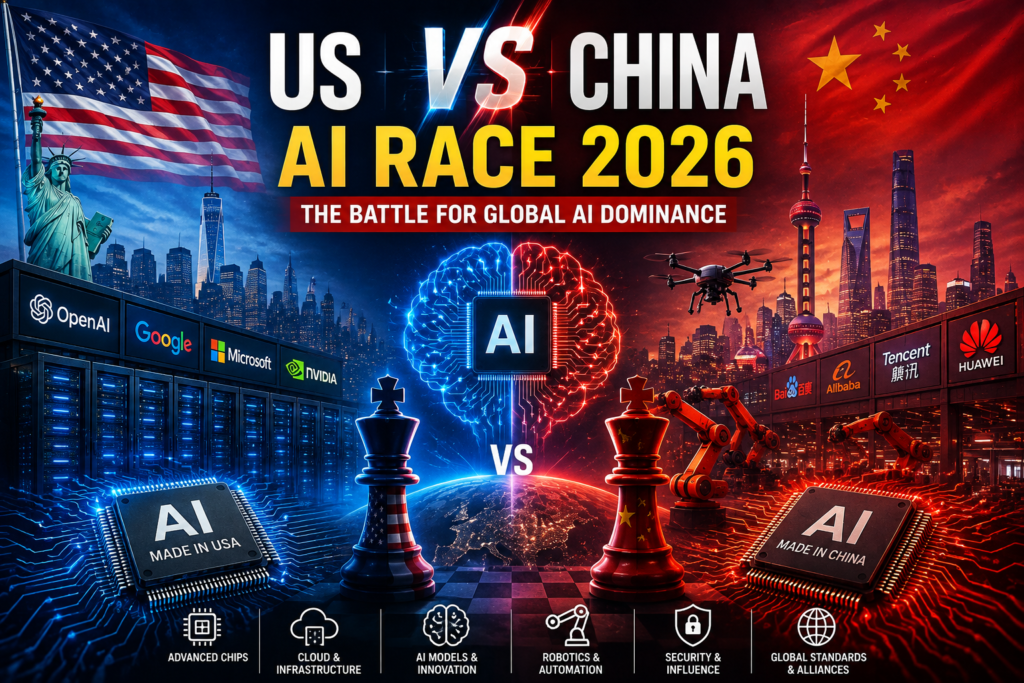
For several years, American companies appeared to have a substantial lead in frontier AI models. Systems from leading U.S. laboratories demonstrated impressive abilities in reasoning, coding, mathematics, multimodal understanding, and agentic tasks.
In 2026, however, that lead is being challenged.
Recent Chinese releases have narrowed performance differences in several areas, while some Chinese companies have emphasized open-weight models that organizations can download, modify, and operate on their own infrastructure.
This creates an interesting contrast. Many leading American AI companies have historically focused on proprietary models delivered through commercial services. Several Chinese competitors have increasingly embraced models that can be accessed and customized more freely.
The Washington Post reported in June that Chinese companies were increasingly focused on making capable models affordable and widely deployable rather than simply winning benchmark competitions.
That distinction could become extremely important.
Imagine two companies needing an AI system to translate documents, analyze customer questions, or assist programmers. If one model is marginally better but dramatically more expensive, a cheaper alternative could still win the market.
Open Weight AI Is Changing the Competition
Open-weight AI has become one of the most interesting developments in the 2026 competition.
An open-weight model can give developers greater control over how an AI system is deployed and customized. This can be attractive to businesses that do not want to send sensitive information to an external service.
Chinese companies have become increasingly competitive in this area. American companies have responded by increasing their own investments in open models.
Reuters reported in August 2026 that Meta and Nvidia were among U.S. companies pursuing open-weight AI strategies as Chinese models gained popularity.
The debate is complicated. Open models can encourage innovation and make AI more accessible, but highly capable systems can also create security and governance concerns. That is why governments are increasingly debating how such technologies should be managed.
Robotics: China's Different Strength
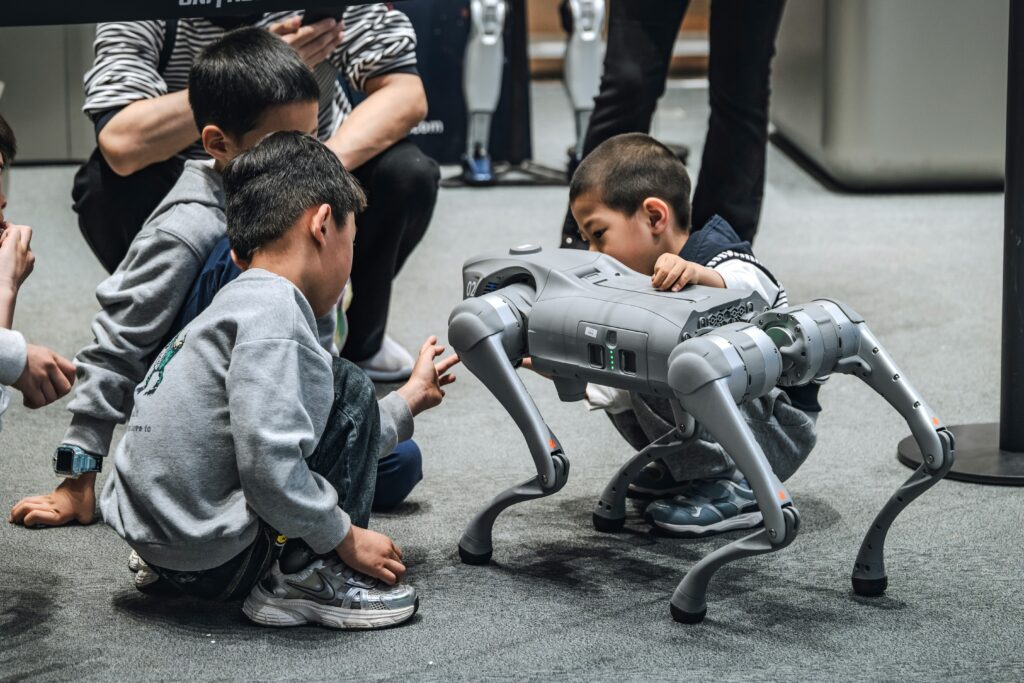
One of the clearest differences between the two ecosystems is physical AI.
China has developed a particularly strong industrial manufacturing base, which gives it an important advantage when artificial intelligence moves from computer screens into physical machines.
Chinese companies are investing heavily in robots, autonomous systems, smart factories, and humanoid robotics. Brookings notes that China currently has an advantage in physical AI innovation, while the United States remains stronger in software and commercial development of sophisticated agentic systems.
Consider a modern factory. AI can analyze production data, while computer vision can identify defective products and robots can perform repetitive physical tasks. The country capable of combining AI software with large-scale manufacturing could gain significant economic advantages.
A Real-Life Example: AI in Global Markets
The competition is already reaching countries outside the United States and China. if you are someone who want to work online check here and see top ten best AI jobs in USA click HERE
Chinese REAI technologies are being adopted in parts of Southeast Asia and the Middle East. A Singapore government-backed AI initiative, for example, selected Alibaba’s Qwen for its technology development, while Chinese companies have also been involved in AI-related projects in Saudi Arabia and other markets.
This demonstrates why global adoption may ultimately matter as much as laboratory benchmarks.
If a country develops an excellent AI model but few organizations use it, its global influence may remain limited. Conversely, an affordable model that becomes deeply integrated into businesses, universities, governments, factories, and consumer applications could become enormously influential.
The Global South and the AI Race
For developing countries, the competition creates both opportunities and challenges.
Countries across Africa, for example, could benefit from affordable AI systems that improve education, agriculture, translation, software development, customer service, and small-business productivity.
However, countries also need to consider data privacy, infrastructure costs, cybersecurity, language support, and dependence on foreign technology providers.
The competition between Washington and Beijing could therefore give developing economies more choices. Instead of relying on a single technological ecosystem, governments and businesses may increasingly compare American, Chinese, European, and locally developed AI systems.
Who Is Winning the AI Race in 2026?
There is no simple answer.
The United States currently has major strengths in frontier models, advanced AI chips, private-sector investment, cloud infrastructure, and the global software ecosystem. China has made impressive progress in model development, AI deployment, manufacturing, robotics, and efforts toward domestic technological self-reliance.
Recent developments suggest that the gap between the two countries is narrowing in some areas. Chinese companies are producing models that can compete strongly on performance and cost, while American companies continue to invest enormous resources into infrastructure and next-generation systems.
Therefore, declaring an outright winner in 2026 would be premature.
The more accurate conclusion is that the competition has entered a new phase.
What Could Determine the Final Outcome?
Several factors could determine which country gains the strongest long-term position.
First is computing power. The ability to obtain and manufacture advanced AI processors remains fundamental.
Second is energy and data-center infrastructure. Powerful models require enormous amounts of electricity and specialized facilities.
Third is talent. Countries need researchers, engineers, entrepreneurs, chip designers, data scientists, and skilled workers capable of developing and deploying AI.
Fourth is commercial adoption. The country whose companies successfully turn AI research into profitable products could gain a significant advantage.
Finally, global partnerships matter. AI leadership increasingly involves alliances, standards, supply chains, and international relationships.
The Future of the US-China AI Competition
The next stage of the competition may be less about building one spectacular chatbot and more about deploying AI throughout the economy.
Agentic AI, robotics, AI-powered scientific research, autonomous systems, advanced manufacturing, and specialized models could become major battlegrounds.
Another important question is whether the United States can maintain its lead in computing while China successfully develops alternatives to foreign semiconductor technology.
The political dimension is also growing. On August 14, 2026, Reuters reported that the United States was preparing to encourage countries participating in American AI initiatives to avoid joining competing Chinese-led initiatives.
That development shows that the AI race is becoming a question of international alignment, not simply technological performance.
What the AI Race Means for Ordinary People
For ordinary users, the competition may appear abstract, but its effects can become visible in everyday life.
A student might use an AI tutor developed by an American or Chinese company. A programmer might use AI coding assistance. A farmer could eventually use AI-powered systems to analyze crops and weather. A manufacturer could use intelligent robots to improve production.
The biggest practical change may be that AI becomes cheaper and more widely available.
Competition between technology companies can push developers to improve performance, reduce costs, and create new applications. At the same time, users need to remain aware that AI systems can make mistakes and that privacy, security, and misinformation remain important concerns.
Conclusion
The US vs China AI race in 2026 is not simply a competition between two countries trying to build the smartest chatbot. It is a much larger contest involving semiconductors, computing infrastructure, software, robotics, scientific research, investment, talent, manufacturing, international alliances, and technological standards.
The United States still holds important advantages, particularly in advanced AI chips, frontier-model development, private investment, and the commercial technology ecosystem. China, however, is moving quickly, particularly in affordable models, open-weight technology, industrial deployment, robotics, and domestic AI infrastructure.
The most important lesson is that there may not be one single winner. Different countries and companies could lead different parts of the AI ecosystem.
What happens next will depend on who can innovate fastest, deploy technology most effectively, build resilient supply chains, attract talent, and convince the rest of the world to adopt its AI ecosystem.
For businesses, students, developers, and policymakers, the message is clear: understanding AI is no longer simply about learning a new technology. It is increasingly about understanding one of the forces shaping the global economy and the balance of technological power.