
What Is Agentic AI? A Complete Beginner's Guide to How Agentic AI Works
Artificial intelligence has evolved rapidly over the past few years. Early AI systems could answer questions, generate text, recognize images, or recommend products. Today, a new generation of intelligent systems is emerge,Agentic AI. Instead of simply responding to prompts, these systems can plan, make decisions, complete multi-step tasks, and adapt their actions to achieve specific goals with minimal human intervention.
If you’ve recently heard the term What Is Agentic AI and wondered how it differs from traditional AI, you’re not alone. Businesses, developers, researchers, and technology leaders are increasingly investing in this technology because it has the potential to automate complex workflows rather than just individual tasks.
This guide is based on industry-recognized AI research, educational resources, and current technology developments.
Whether you’re completely new to AI or already familiar with machine learning, this guide explains Agentic AI in simple language while providing enough depth to understand why it is considered one of the most important AI trends of 2026.
Featured Snippet Answer
What is Agentic AI?
Agentic AI is a type of artificial intelligence designed to independently pursue goals by planning actions, making decisions, using external tools, learning from feedback, and adapting to changing situations. Unlike traditional AI models that only respond to individual prompts, Agentic AI can complete entire workflows with limited human supervision.
Table of Contents
- What Is Agentic AI?
- How Does Agentic AI Work?
- Core Components of Agentic AI
- Agentic AI vs Traditional AI
- Real-World Applications
- Benefits of Agentic AI
- Challenges and Limitations
- The Future of Agentic AI
- Best Agentic AI Tools in 2026
- How Beginners Can Learn Agentic AI
- Frequently Asked Questions
- Disclaimer
- Final Thoughts
What Is Agentic AI?
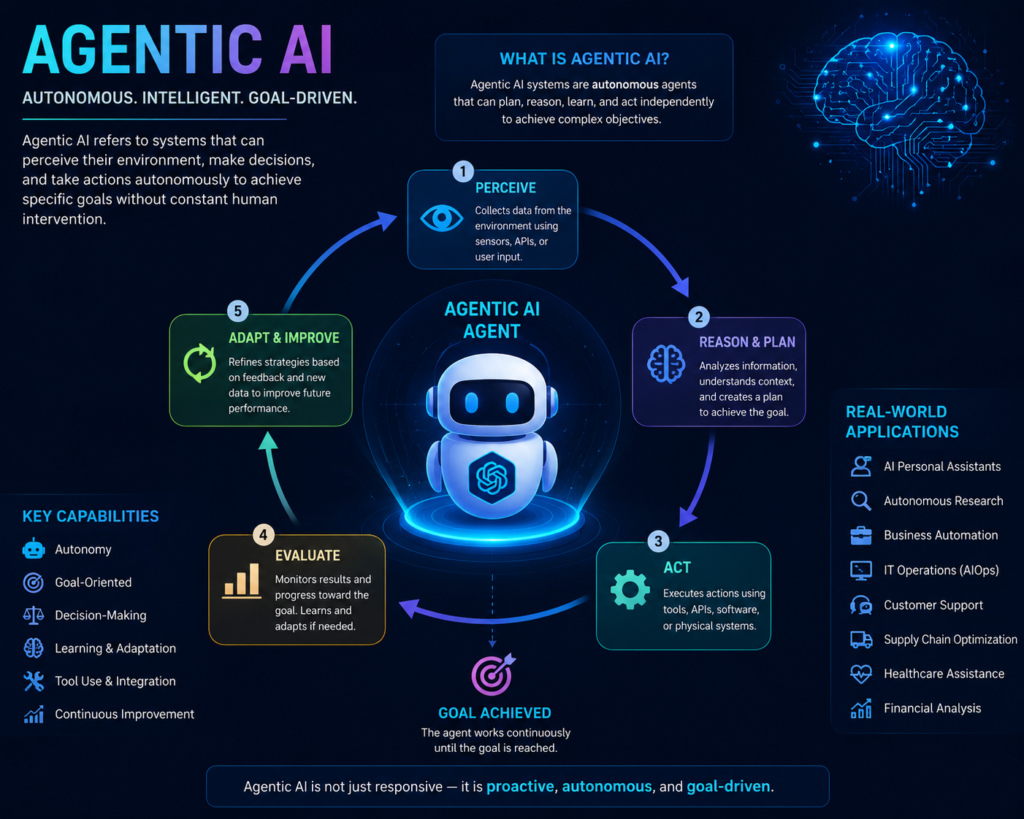
Agentic AI refers to intelligent software systems capable of acting like autonomous digital agents. Instead of waiting for users to provide every instruction, these systems understand objectives, create action plans, execute tasks, evaluate progress, and adjust strategies when necessary.
Think of traditional AI as a calculator—it performs exactly what you request. Agentic AI behaves more like a project assistant. If you ask it to organize a business trip, it may research flights, compare hotels, build an itinerary, estimate costs, send reminders, and recommend schedule adjustments without requiring constant guidance.
The defining feature is autonomy. Agentic AI is goal-oriented rather than prompt-oriented. It focuses on achieving outcomes instead of generating isolated responses.
This shift represents a major step toward more capable and practical AI systems that can handle increasingly sophisticated responsibilities.
How Does Agentic AI Work?
Agentic AI combines several advanced AI technologies into a coordinated decision-making system.
The process typically begins with understanding a user’s objective. Rather than immediately producing an answer, the AI analyzes the goal and breaks it into manageable steps.
Next, it creates a strategy for completing each task. It may search databases, access software applications, analyze documents, communicate with APIs, or retrieve information from trusted knowledge sources.
As the system progresses, it evaluates whether its actions are producing the desired results. If obstacles appear, Agentic AI can revise its plan, choose different tools, or attempt alternative approaches.
Finally, the completed work is delivered while maintaining context throughout the entire workflow.
Unlike traditional chatbots that forget objectives after each response, Agentic AI continuously monitors progress until the overall goal has been achieved. Also learn here more about Generative AI and Enjoy Click HERE
Core Components of Agentic AI
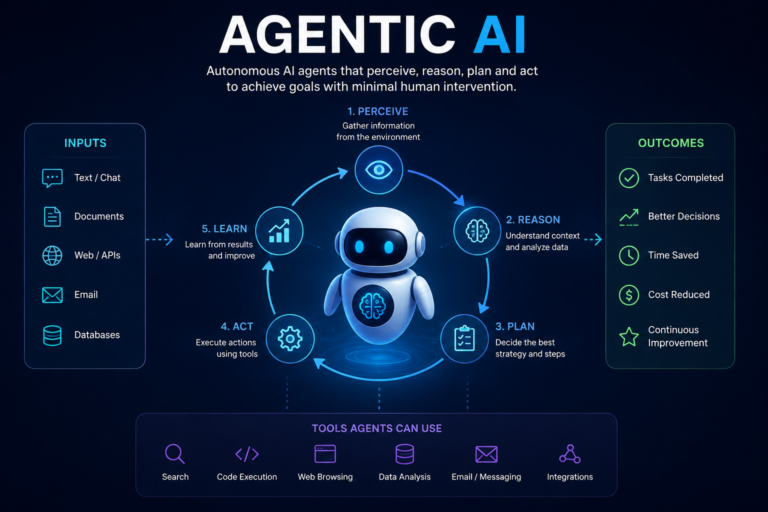
Several technologies work together to make Agentic AI possible.
Large Language Models
Modern language models allow AI to understand instructions, generate natural conversations, summarize information, and reason through complex problems.
Planning
Planning enables AI to divide large objectives into smaller actionable tasks. Instead of solving everything at once, it builds logical sequences that improve efficiency.
Memory
Persistent memory allows the system to remember previous interactions, project requirements, user preferences, and completed tasks, enabling longer and more coherent workflows.
Decision-Making
Agentic AI evaluates multiple options before selecting the most effective action. It weighs available information instead of simply generating text.
Tool Usage
One of the biggest advancements is the ability to use external software such as calendars, spreadsheets, databases, search engines, customer relationship management systems, and business applications.
Feedback Loops
After completing each action, the AI reviews outcomes, identifies mistakes, and adjusts future decisions. Continuous improvement is essential for autonomous operation.
Agentic AI vs Traditional AI
Traditional AI systems excel at answering questions, writing content, translating languages, or recognizing images. However, every action usually requires a separate instruction.
Agentic AI expands beyond this limitation by connecting multiple actions into one continuous workflow.
For example, a traditional chatbot may draft an email when asked.
An Agentic AI assistant could draft the email, verify appointment availability, attach relevant documents, schedule a meeting, update the project tracker, and remind participants automatically.
This ability to coordinate multiple tasks makes Agentic AI significantly more practical for business operations. Check on Amazon And buy For yourself Best AI pro voice recorder Click HERE
Real-World Applications of Agentic AI
Organizations across many industries are beginning to integrate Agentic AI into everyday operations.
Customer support teams use intelligent agents to resolve inquiries, escalate complex issues, and personalize responses.
Software developers rely on AI agents that write code, detect bugs, run automated testing, and suggest improvements before deployment.
Marketing professionals use Agentic AI to conduct keyword research, analyze competitors, generate content calendars, optimize campaigns, and monitor performance metrics.
Businesses employ autonomous agents for inventory management, supply chain optimization, report generation, financial forecasting, and workflow automation.
Researchers benefit from AI systems capable of reviewing scientific literature, organizing findings, generating summaries, and identifying knowledge gaps.
Personal productivity assistants can organize schedules, prioritize tasks, summarize meetings, and coordinate daily activities with minimal supervision.
Benefits of Agentic AI
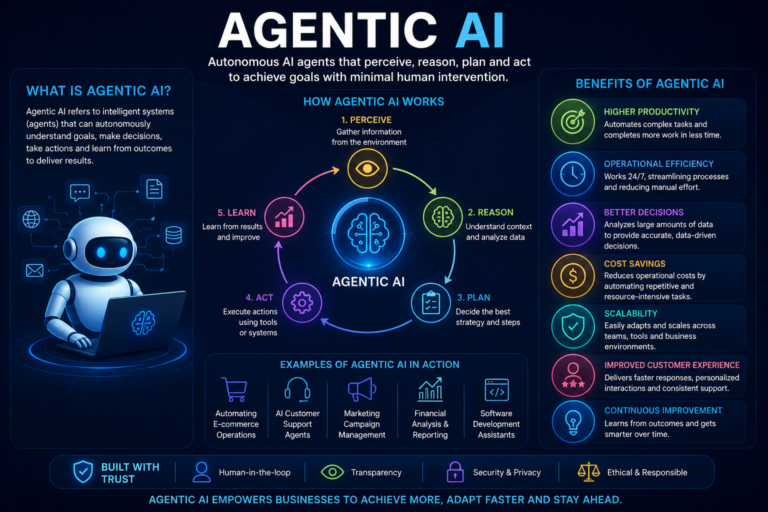
Agentic AI offers significant advantages over earlier generations of artificial intelligence.
One major benefit is increased productivity. Autonomous agents eliminate repetitive manual work, allowing employees to focus on strategic and creative responsibilities.
Another advantage is faster decision-making. Because AI processes large amounts of information quickly, businesses can respond more efficiently to changing conditions.
Consistency is another strength. AI agents perform standardized tasks accurately while reducing human error.
Scalability also makes Agentic AI attractive. Organizations can deploy numerous AI agents simultaneously to support customer service, operations, analytics, and internal workflows without proportionally increasing staffing costs.
Finally, continuous learning enables long-term performance improvements as systems receive additional feedback and updated knowledge.
Challenges and Limitations
Despite impressive capabilities, Agentic AI is not without challenges.
Autonomous systems require strong oversight to prevent unintended actions. Organizations must define clear goals, permissions, and operational boundaries.
Data quality also remains essential. Poor or inaccurate information can lead to incorrect recommendations or ineffective decisions.
Privacy and cybersecurity are growing concerns because AI agents often access multiple business systems containing sensitive information.
Ethical considerations include transparency, accountability, fairness, and responsible deployment.
Although Agentic AI appears highly intelligent, it can still misunderstand context, generate inaccurate conclusions, or make planning mistakes. Human review remains important for critical decisions.
The Future of Agentic AI
Industry experts expect Agentic AI to become one of the defining technologies of the coming decade.
Future systems will collaborate with one another, coordinate across multiple software platforms, and handle increasingly sophisticated business operations.
Organizations may eventually employ specialized AI agents dedicated to finance, customer service, legal research, marketing, software engineering, cybersecurity, and operations management.
Rather than replacing people entirely, Agentic AI is expected to function as an intelligent digital workforce that enhances productivity while allowing humans to concentrate on creativity, leadership, innovation, and complex judgment.
As governance frameworks improve, adoption is likely to accelerate across nearly every industry.
Best Agentic AI Tools in 2026
The Agentic AI ecosystem continues to grow rapidly. Some of the most widely recognized platforms include OpenAI ChatGPT with agent capabilities, Microsoft Copilot, Google Gemini, Anthropic Claude, CrewAI, AutoGen, LangGraph, and OpenHands.
These tools help automate research, software development, document analysis, project management, workflow orchestration, and enterprise productivity.
Each platform offers different strengths depending on whether the focus is coding, collaboration, reasoning, business automation, or autonomous task execution.
How Beginners Can Learn Agentic AI
Learning Agentic AI does not require an advanced computer science degree.
Start by understanding artificial intelligence fundamentals, including machine learning, neural networks, and language models. Next, explore prompt engineering to communicate effectively with AI systems.
As your confidence grows, study AI agents, automation frameworks, Python programming, APIs, and workflow orchestration platforms.
Hands-on practice is essential. Experiment with building small AI assistants that complete practical tasks such as summarizing documents, scheduling activities, or automating research.
Following trusted educational resources, academic publications, and technology companies will help you stay informed as Agentic AI continues evolving.
Frequently Asked Questions
- What makes Agentic AI different from regular AI?
Agentic AI focuses on achieving goals rather than simply answering prompts. It plans, reasons, uses tools, remembers context, and completes multi-step tasks with limited supervision.
- Can Agentic AI think like humans?
No. Agentic AI can simulate reasoning and decision-making but does not possess consciousness, emotions, or genuine human understanding.
- Is Agentic AI the same as machine learning?
No. Machine learning is one technology used to build AI systems. Agentic AI combines machine learning, language models, planning, memory, and autonomous decision-making.
- Does Agentic AI replace human workers?
It is more likely to automate repetitive activities while supporting human professionals in complex work rather than completely replacing them.
- Is Agentic AI safe?
It can be safe when organizations implement strong security controls, governance policies, human oversight, and responsible AI practices.
- Which industries benefit most?
Technology, healthcare, finance, education, manufacturing, logistics, retail, customer service, and software development are among the fastest adopters.
- Can small businesses use Agentic AI?
Yes. Many cloud-based AI platforms now provide affordable automation solutions suitable for startups and small businesses.
- Do I need programming skills?
Basic programming helps but is not always required. Many modern AI platforms provide visual interfaces that reduce technical barriers.
- What skills should beginners learn first?
Start with AI fundamentals, prompt engineering, basic Python, APIs, automation concepts, and responsible AI principles.
- Will Agentic AI continue improving?
Yes. Researchers continue advancing reasoning, memory, planning, multimodal understanding, collaboration between AI agents, and enterprise automation capabilities.
Disclaimer
Artificial intelligence technologies evolve rapidly, and new capabilities, tools, and best practices emerge frequently. The information presented in this article is intended for educational purposes only and reflects current technology developments and industry understanding as of 2026. Readers should verify important technical, legal, or business information using trusted sources before making significant decisions. This content should not be considered professional technical, legal, or financial advice.
Final Thoughts
Agentic AI represents a significant evolution in artificial intelligence. Instead of merely responding to questions, these intelligent systems can plan, reason, use tools, and execute complex workflows with increasing independence. As organizations continue adopting autonomous AI solutions, understanding how Agentic AI works will become an essential digital skill for professionals, students, developers, and business leaders alike.
While the technology is powerful, responsible implementation remains just as important as innovation. Human oversight, ethical governance, data quality, and security will determine how successfully Agentic AI is integrated into society. By building a solid understanding today and continuing to follow emerging research and trusted educational resources, you’ll be well prepared to take advantage of the next generation of intelligent technologies.